How an Engineering Firm Manages 12 Projects in Parallel Without Missing a Deadline
- Roberto Benanti
- Apr 3
- 3 min read


For an engineering or architecture firm, managing a single project is already complex. Managing 12 in parallel, with partially overlapping teams, rigid contractual deadlines, and different clients asking for updates asynchronously, is a structural coordination problem that good intentions alone can't solve.
In this article we share how an engineering firm we work with, 18 professionals between in-house staff and external consultants, tackled this problem with Wrike, and what changed concretely in the way they manage their projects.
The problem before Wrike: everything lived in emails and project files
Before working with us, the firm managed projects with a mix of emails, shared folders on an internal server, and an Excel sheet to track main deadlines. The sheet was updated by the project lead, but not always in real time.
The most frequent problems they described to us:
Zero visibility on the real status of projects. The principal couldn't know, without making a round of calls, where the 12 active projects stood. Every week he spent almost 2 hours just collecting status updates.
Missed deadlines due to coordination gaps. On two occasions in one year, the delivery of drawings to a client was delayed because someone was waiting for an input that hadn't been formalised as a dependency. Nobody knew a task was blocked until it was too late.
External consultants not integrated into the workflow. External professionals received assignments by email, had no visibility into the project context, and often delivered work without knowing that another part of the project had changed in the meantime.
How we structured Wrike for this firm
The structure we built mirrors the operational model of a technical firm: each project is a Wrike project, with a standard hierarchy of phases (preliminary design, definitive design, construction documents, site supervision) that repeats across every project with minimal variations.
Project template. We built a Wrike template that gets duplicated for every new project. It already contains all phases, recurring tasks, task dependencies, and relevant custom fields (project number, client, contract value, contractual delivery date). Opening a new project takes under 10 minutes.
Portfolio dashboard. The principal has a dashboard that shows at a glance the status of all active projects: which are on track, which have overdue tasks, which require immediate attention. No need to ask the team for this overview.
External consultants on Wrike. External professionals were added as collaborators in Wrike with limited access to the projects they're involved in. They receive notifications on assigned tasks, see project context, and deliver work directly in the system instead of sending emails.
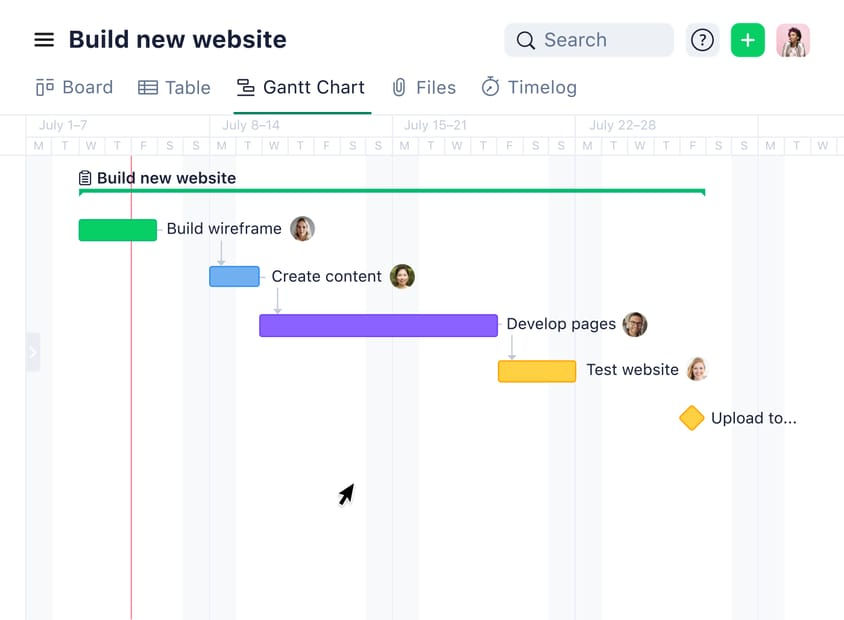
Task dependencies. Every activity that depends on another is explicitly linked in Wrike. When a delivery slips, Wrike automatically recalculates the impact on downstream tasks and notifies the relevant people.
Results after 4 months
We measured results 4 months after the full implementation. The most significant changes:
• Weekly time spent collecting status updates reduced from about 2 hours to under 20 minutes.
• Zero missed deadlines in the 4 months following implementation, compared to 2 incidents the previous year.
• External consultants stopped sending emails asking for project updates: they find everything in Wrike.
• Opening a new project went from about 2 hours of manual setup to under 10 minutes thanks to the template.
"Before, I spent my Monday mornings on the phone trying to understand where we stood. Now I open Wrike at 8:30 and in 15 minutes I know exactly the status of every project." Principal, structural engineering firm.
Do you manage multiple projects in parallel and struggle to keep everything under control?
At SBK Solutions we support engineering and architecture firms in implementing Wrike, from project structure to dashboard configuration. Our starting point is always how you work: we understand your processes first, then we build the right tool.
Or read all articles in the Wrike & Project Management category.